July 3, 2026 —– Chart #357
Hello music friends,
Welcome back to another edition of Chart of the Week. Since this one lands on July 3rd, right before Independence Day, I thought we needed something with a little red, white, blue, and maybe a brown paper bag in the back of a pickup truck.
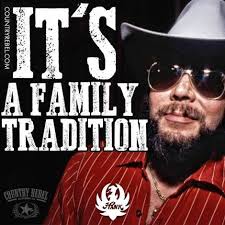
Today’s feature is “Family Tradition” by Hank Williams Jr., also known far and wide as Bocephus.
That nickname came from his father, Hank Williams, who reportedly thought little Hank Jr. resembled a Grand Ole Opry ventriloquist dummy named Bocephus. That may not be the most flattering origin story in country music, but it sure beats being nicknamed “Tax Return” or “Transmission Fluid.”
This is one of those songs that is part country hit, part autobiography, part declaration of independence, and part warning label.
Hank Jr. steps out of the shadow
Being the son of Hank Williams had to be both a blessing and a pretty heavy load. Hank Sr. was one of the most important figures in the history of country music, and he died when Hank Jr. was only three years old. For much of his early career, Hank Jr. was expected to sing his father’s songs, dress the part, and carry on the Williams name in a respectful, traditional way.
Eventually, Bocephus decided he had enough of that.
By the late 1970s, Hank Jr. had grown his hair, put on the hat and sunglasses, and built a sound that mixed country, Southern rock, blues, and a whole lot of attitude. His 1979 album Family Tradition was a major turning point, and the title song became one of his signature numbers. It reached No. 4 on the Billboard country chart and helped establish Hank Jr. as his own man, not just the son of a legend.
The song
“Family Tradition” was written and recorded by Hank Williams Jr. and released in 1979. It is a direct answer to everyone who kept asking him why he lived the way he did, sang the way he did, drank the way he did, and did not simply become a museum exhibit for his father’s legacy.
His answer was simple: it was a family tradition.
The song mentions his famous father, his mother Audrey, and the public pressure that followed him everywhere. It is funny, defiant, and more honest than it probably had any legal obligation to be.
That is part of why people still love it. Hank Jr. is not asking for permission in this song. He is not apologizing. He is explaining himself, but just barely. Mostly, he is telling the world to stop acting surprised. And to boot, he pulled out an old country nickname for a doctor, “Sawbones”. You gotta love that.
Why it connected
Country music has always loved songs about family, trouble, drinking, hard living, and personal independence. “Family Tradition” puts all of that in one package. It is not polished Nashville dinner music. It is barroom biography.
It also gave Hank Jr. a way to separate himself from his father while still honoring where he came from. He was not rejecting the Williams legacy. He was claiming it on his own terms.
That is a pretty good trick. Most of us have a hard enough time explaining family traditions that involve who brings the deviled eggs to Thanksgiving.
A quick note for the guitar crowd
This is a great acoustic guitar song if you are in the right crowd. It is not complicated, and it does not need to be. The song works best when played loose, confident, and with a little swagger.
It is also a participation song. If you play it around people who know it, they are going to sing along whether you invited them or not. That can be good or bad depending on the people and the number of beverages already involved.
Either way, this one has held up because it is honest, catchy, and unmistakably Hank Jr.
So this week, in honor of family, independence, and the occasional questionable decision passed down through the generations, we are going with “Family Tradition.”
Keep Rockin,
Stan