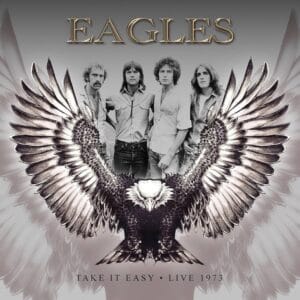
February 27, 2026 —– Chart #339
Hello Music Friends,
Welcome back to another edition of Chart of the Week. This week we’re grabbing the acoustic, loosening the shoulders, and heading out on the open road with “Take It Easy” by The Eagles. I’ve played this one a whole bunch of times on stage myself. Now, have I ever sounded as good as the original Eagles? Not even close. Those guys set a bar that’s basically hovering somewhere above the ozone layer. But for an Arkansas-born, self-taught guitar player who wound up in Texas… I’ll say this: it’s usually not bad. And more importantly, it’s always fun.
And part of why it’s so fun is because the original version is the definition of “sounds easy… but it’s not.”
The original recording: relaxed on the surface, locked in underneath
What most people hear is the laid-back vibe. What musicians hear is discipline.
The Eagles cut the original in early 1972 at Olympic Sound Studios in London with Glyn Johns producing. That detail cracks me up, because the song feels like Arizona asphalt and Southern California sunshine, yet it was captured an ocean away in a very serious studio with a very serious producer.
And that producer mattered. Glyn Johns had a knack for recording bands like bands—players in a room, tight but not stiff, with air around the instruments. That’s exactly what “Take It Easy” needs. If you over-produce it, you crush the charm. If you under-produce it, it turns into a loose rehearsal tape. The original threads the needle.
There’s also one of those small, genius touches that makes the track pop: the banjo part. The band wasn’t automatically sold on it at the time, but it adds this fizzy little sparkle—like carbonation in the groove. It’s not “hey look, we added a banjo.” It’s more like a rhythmic texture that keeps the whole thing buoyant.
Who wrote it, and how it became an Eagles signature
The song was written by Jackson Browne and Glenn Frey, and the story I love is that it wasn’t fully finished until it was. Browne had the core of it, Frey helped bring it across the goal line, and out comes one of the most visual lyrics in rock history—yes, that line about a girl in a flatbed Ford. That’s not just a lyric; it’s a movie scene.
And it’s worth remembering: this was their debut single. They weren’t “The Eagles” yet in the legendary sense. They were a new band coming out of that early-’70s Linda Ronstadt orbit, trying to prove they were more than a good-looking backing group with nice hair and better harmonies. This record is them planting the flag.
The core lineup on the track is a big part of why it works:
- Glenn Frey on lead vocal and acoustic rhythm
- Don Henley on drums and harmony vocal
- Randy Meisner on bass and harmony vocal
- Bernie Leadon on guitar/banjo and harmony vocal
That matters because this is not a “lead singer plus band” song. It’s a blend song. The harmonies aren’t decoration—they’re the identity.
What the song is really about?
On paper, it’s a travel song. In reality, it’s a life management strategy.
The narrator is juggling too many variables: women, trouble, speed, and the creeping suspicion that his own brain might be the loudest engine on the highway. Then comes the advice that every adult male in America needs stitched somewhere into his daily routine:
Take it easy.
Not “quit.” Not “give up.” Not “move to a cabin and whittle.” Just… take it easy. Dial it back a notch. Stop letting the sound of your own wheels drive you crazy.
That advice gets more relevant every year you’re alive.
How it did on the charts?
For a debut single, it was a rocket launch. It climbed to No. 12 on the Billboard Hot 100—plenty high enough to announce, loudly, that these guys weren’t going away.
What it’s like to play live
Here’s my field report after doing it on stage more times than I can count:
- The right hand matters more than the left.
The chords are friendly. The groove is the hard part. Your strum has to stay light, steady, and a little bouncy—like the song is riding on air. - The song has to feel relaxed without getting sloppy.
That’s the same trick the original recording pulls off. Easy vibe, tight execution. - The intro lick is punctuation, not a solo.
Clean, short, confident. Don’t chase it. Drop it in like a period at the end of a sentence. - If you’ve got harmony singers, you’ve got a weapon.
Even one solid harmony makes this tune feel like the real deal. Two harmonies and you’re suddenly doing the Eagles thing—at least for three minutes.
And here’s the part I’ve learned the hard way: most people aren’t judging you against the record as much as you think they are. They’re judging you on whether you sell the song—whether it feels good, whether it swings, whether it makes them smile, and whether they can sing along without feeling self-conscious.
If you can do that, you’re doing the job.
So if your week is already loud, or fast, or a little too crowded with problems you can’t solve today… put this one on the stand, grab the guitar, and do what the song says.
Take it easy.
Keep Rockin’,
Stan Bradshaw