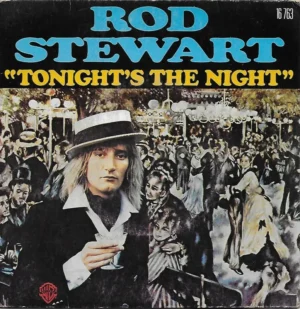
July 10, 2026 —– Chart #358
Hello music friends,
Welcome back to another edition of Chart of the Week. This week’s selection is a little different from many of the songs I feature here. It is a little racy, a little suggestive, and not exactly the kind of tune you would expect to hear at vacation Bible school.
But it is catchy, it was a huge hit, and it features one of the most distinctive voices in rock and roll.
Today’s song is “Tonight’s the Night (Gonna Be Alright)” by Rod Stewart.
You either love this one or you don’t. But give it a try.
Rod the raspy romantic
By 1976, Rod Stewart was already a major star. He had been the lead singer for Faces, had a successful solo career, and had already given the world “Maggie May,” “You Wear It Well,” and a whole catalog of songs that sounded like they had been sung by a charming rascal who had just come from either a soccer match, a pub, or both.
Rod’s voice has always been the whole deal. It is raspy, soulful, frayed around the edges, and somehow both rough and tender at the same time. Plenty of singers can hit prettier notes. Not many can make a line sound like Rod Stewart. He sings like he has lived a little, stayed out too late, and misplaced at least one jacket along the way.
That voice is a big reason “Tonight’s the Night” works.
The song
“Tonight’s the Night” was written by Rod Stewart and recorded for his 1976 album A Night on the Town. It was recorded at the famous Muscle Shoals Sound Studio in Alabama, which is always a pretty good place to be if you are trying to put some soul into a record.
The song became one of the biggest hits of Rod’s career. It went to No. 1 on the Billboard Hot 100 in November 1976 and stayed there for eight weeks. It also became Billboard’s No. 1 song for 1977.
That is a pretty strong showing for a song that caused a fair amount of pearl-clutching when it came out.
The lyrics were controversial at the time, and some radio stations were not quite sure what to do with it. Rod’s then-girlfriend, actress Britt Ekland, can be heard near the end of the recording with the spoken French part, which only added to the song’s breathy reputation.
Subtle it was not.
Why it worked
The funny thing is, underneath all the controversy, this is really a very well-built pop song. The melody is smooth, the arrangement is warm, and the whole record has that soft 1970s glow. It is not loud. It does not rock particularly hard. It just slides along with confidence.
Rod does not oversing it. He lets the song simmer. That is probably the right verb.
There is also a sweetness to the music that offsets some of the lyrical boldness. In the hands of a lesser singer, this song might have become pure lounge-lizard material. With Rod, it has charm. Maybe dangerous charm, but charm nonetheless.
A quick note for the guitar crowd
This one can work nicely on acoustic guitar if you keep it relaxed. Do not try to turn it into a campfire stomp. It needs a smooth touch and a steady rhythm. The song is more about feel than flash.
It is also one of those songs where the singer matters. If you are going to sing it, you have to lean into it a little. Not too much. There is a fine line between “Rod Stewart swagger” and “guy at the wedding reception who has had too much confidence.”
Proceed carefully.
Still, it is a great example of how a simple progression, a memorable melody, and a one-of-a-kind voice can create a massive hit.
So this week, we give a nod to Rod Stewart, his unmistakable voice, and one of the biggest, smoothest, and most eyebrow-raising hits of the 1970s.
Keep Rockin,
Stan