August 21, 2026 —– Chart #364
Hello Music Friends,
The most famous father-and-son conversation in popular music is not about a father and son. It’s about the Russian Revolution. I’ll give you a minute with that one.
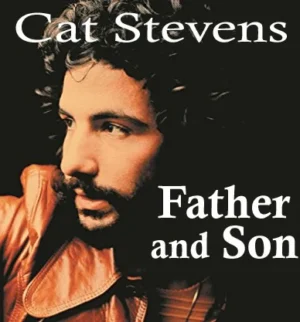
In 1969 Cat Stevens was writing a musical called Revolussia, set in 1917 Russia, about a boy who wants to run off and join the revolution over the objections of his conservative farmer father. “Father and Son” was their big scene. Then Stevens contracted tuberculosis, came close to dying, and spent the better part of a year in a hospital bed with a collapsed lung, which will end a musical project and rearrange your priorities all in one stroke. The musical evaporated. The song survived. And somewhere between the hospital and the studio, it stopped being about Russia and started being about every kitchen table where a father and a son have ever talked past each other.
The song landed on Tea for the Tillerman in 1970, and here’s the fact that stops people cold: it was never a hit single in America. Never even released as one. It rode along as the B-side of “Moon Shadow” and got its fame the honest way, through FM radio and word of mouth, one worn-out album groove at a time. Some songs need a chart position. This one just needed time.
You know the trick at the heart of it. Stevens sings the father’s verses down low — patient, measured, “find a girl, settle down.” Then he lifts into his higher register and becomes the son, all ache and frustration, “how can I try to explain?” One man, both sides of the argument. Asked whose side he was on, Stevens gave an answer I’ve never forgotten: “How could I have sung the father’s side if I couldn’t have understood it, too?” He said he once heard the song on the radio and realized one of those lines was his father’s father’s father’s father speaking. That’s not songwriting anymore. That’s ancestry.
And his own father? “I’ve never really understood my father, but he always let me do whatever I wanted — he let me go,” Stevens said. “‘Father and Son’ is for those people who can’t break loose.” The man wrote the argument he never had to have. Lucky him. The rest of us hear our own houses in it.
Everybody has taken a swing at this song. Johnny Cash cut it twice, once as “Father and Daughter” with his stepdaughter Rosie Nix Adams and once with Fiona Apple. Boyzone — an Irish boy band, and no, I can’t name a second Boyzone song either — took it to No. 2 in the UK in 1995. Ronan Keating did it again in 2004 with Yusuf himself singing the father’s lines. Rod Stewart had a go in 2006. And the Flaming Lips wrote a song called “Fight Test” that sounded so much like “Father and Son” that Cat’s publishers now collect 75 percent of its royalties. The Lips’ frontman apologized publicly and added, “Cat Stevens is never going to make much money out of us.” A songwriter’s apology if I ever heard one.
But the version that gets me is Yusuf’s own. In 2020, at age 72, he re-recorded the song for Tea for the Tillerman 2 — and kept his original 1970 vocal for the son’s parts. The 22-year-old sings the son. The 72-year-old sings the father. The kid finally got his answer; it just took fifty years to arrive. If that doesn’t put a lump in your throat, check your pulse. (Hollywood knows what it has here, too — this is the song playing over the funeral at the end of Guardians of the Galaxy Vol. 2, and the Ted Lasso finale reached for it as well. When a scene needs the sound of generations letting go, there’s really only one number to call.)
Playing it is a joy, and for once no capo required — straight G major, the shapes you learned first: G, C, D, Em, Am, with a Bm passing through. The intro figure is a little hammer-on run off the G chord that announces the song in two seconds flat, and it’s easier than it sounds — let the open strings do the work. Keep the strum soft and rolling underneath, like Alun Davies did on the second guitar. The real assignment is the vocal. You get to play both parts: settle your voice down low and steady for the father, then let it climb and strain a little for the son — the strain is the point. Sing it around a campfire with actual fathers and sons present and see what happens to the conversation afterward. I’ve seen it. It works.
Keep Rockin’,
Stan Bradshaw